Bar Chart
Bar chart consists of rectangular bars that represent the changes over a period of time or for comparing data values of some objects. This simple bar chart displays the revenue a company gets selling its products.
A Bar Chart (Bar Graph) displays data with rectangular bars whose sizes are proportional to the values they show. The chart presents compared categories on one axis and their corresponding values - on the other.
Line Chart
Basic multi-series line chart that shows the changes the different product sales changes over time.
Single-Series 3D Area Chart
A 3D Area Chart demonstrating the ACME Corporation shares' price cost changes in September (from site N)
Stacked Area Chart
Stacked Area Charts with Region-wise sales information. Stacked mode helps to present data as a sum of a whole.
Stacked Bar Chart
Stacked Bar chart displays sales breakdown for multiple products in several regions. Stacked mode helps to concentrate on comparing sales in all regions while being able to compare total sales as well.
Stacked Bar Chart with Negative Values
Stacked bar charts are used to compare the quantitative value each part of the category brings to the whole category. This chart shows the distribution of the revenue got from the cosmetic products sold to men and women.
Vertical Line Chart with Logarithmic Scale
Customers activity vertical line chart with logarithmic scale to show data set with a big difference between the values.
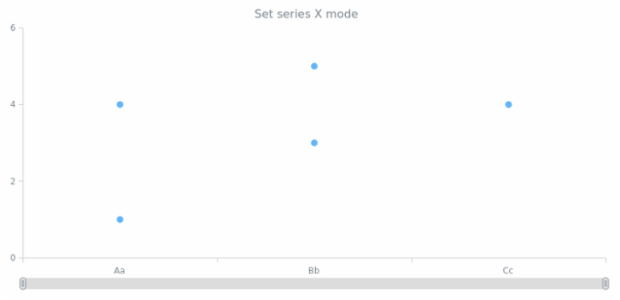
anychart.core.cartesian.series.Marker.xMode
Bubble Chart
A Bubble Chart depicts three dimensions of data: two of them are x- and y-coordinates and the third one is the size of a circle which is plotted as a data point. This chart type facilitates the understanding of different relationships.